
Why Cookie‑Based Attribution and IP‑Based Targeting Don’t Always Align
In B2B marketing, companies no longer only want to reach individuals. They need to persuade organisations. This shift in understanding and focus has given rise to account‑based marketing, B2B intent data, and company‑level visitor analytics. But behind the scenes, two very different technologies are being used to define what a “company” actually is on the internet.
One is based on network ownership, using IP addresses and internet registries. The other is based on people, using cookies, devices and fingerprinting data. Both are useful. But they describe different realities and confusing them leads to misleading expectations.
How IP-Based Company Level Identification Works in B2B Advertising
IP‑based company identification works by resolving who owns the network from which traffic originates. Every organisation that connects to the internet does so through IP ranges registered with regional internet registries such as RIPE or ARIN*. These define which company controls which networks. This data is stable, auditable and externally verifiable. It is the foundation of how B2B programmatic advertising works because advertising platforms buy access to networks, not to people.
When an IP range belongs to a company, it can be targeted, excluded, frequency‑capped and reported on. This is what makes account‑based advertising possible at scale. It is deterministic: the company owns the infrastructure.
*NOTE: for more detail about the way internet registries work, see here https://www.ripe.net/community/internet-governance/internet-technical-community/the-rir-system/
How Cookie-Based Company-Level Identification Works in B2B Analytics
Cookie‑based company identification works differently. It observes user behaviour: cookies, email clicks, form fills, device IDs and browsing patterns. From these signals, platforms infer where a person might work. This is extremely useful for understanding interest and triggering sales activity. But the inferred company is attached to the person, not to the network they are currently using.
When Cookie-Based and IP-Based Company-Level Identification Align and When They Don’t
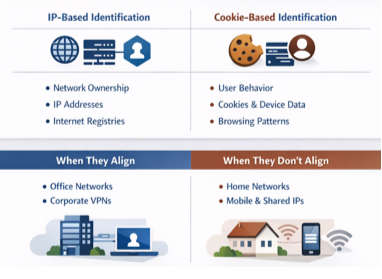
Sometimes these two worlds overlap. If someone is browsing from their office or corporate VPN, their IP address may also belong to their employer. In those cases, cookie‑based inference and IP‑based targeting align perfectly.
But in today’s remote and mobile world, much B2B traffic comes from home broadband, mobile networks, shared VPNs and IPv6 carrier networks. These IPs are dynamic and shared by thousands of users. They are not owned by any single company. A person may truly work for an organisation, yet the network they use cannot be targeted as that organisation in advertising.
This creates a gap between what marketers can see in B2B platforms/SaaS analytics and what they can reach. Analytics platforms may show interest from a company, but programmatic platforms may not be able to activate that company at network level. Some platforms often blend IP and cookie data to increase coverage, but that does not remove this structural boundary.
What This Means for Account-Based Marketing and B2B Activation
Understanding this distinction is critical for B2B performance. Cookie- and fingerprint-based platforms tell you which company names appear to be interested. IP-based systems tell you where media can actually be delivered. Both are useful but they do not operate on the same layer of the digital ecosystem.
Most B2B analytics and visitor-identification platforms use first-party or session-level cookies, device fingerprints, email clicks and form activity to infer which companies may be in-market or visiting your site. This creates valuable visibility into account-level interest. However, these identifiers are not media-addressable: in most cases they cannot be passed into programmatic platforms such as DV360, Xandr or Adform to buy impressions against those users.
Media activation requires advertising-level identity such as IP-based network ownership or privacy-safe ID frameworks (for example LiveRamp or UID-style IDs) that SSPs and DSPs can recognise at bid time. Most B2B analytics cookies do not exist in that layer of the ecosystem.
This creates a structural boundary in B2B go-to-market. You may be able to see interest from an account via cookies and fingerprints, but you can only activate that account where its traffic runs through corporate IP infrastructure that can be targeted, controlled and reported on.
The strongest B2B strategies respect this separation. Visibility and addressability are not the same thing, and confusing them leads to wasted spend and misleading performance metrics.
AccountInsight is built on this principle: clean, auditable, network-level company identity for compliant, scalable B2B activation.