Most B2B marketers think in terms of companies. However, most advertising platforms still think in terms of users. That mismatch is the root cause of wasted media spend, weak attribution, and ineffective account-based marketing.
B2C platforms such as Meta, Instagram, Google Display and most mainstream DSPs were built to identify, track and retarget individuals. B2B advertising works differently. In B2B, the buying decision belongs to organisations, not to devices or people.
AccountInsight was built on a simple principle:
“B2B display advertising should target companies, not guess which users might belong to them. To make that possible, the entire programmatic stack has to be rebuilt around a company-level identifier that is stable, auditable and usable for media buying. That identifier is the corporate IP network.”
Why Corporate IP Networks Are the Only Deterministic Company Identifier
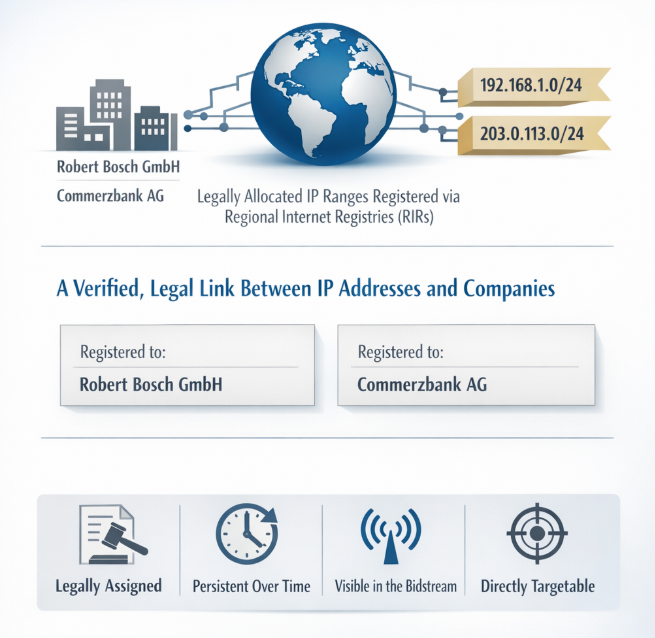
Every organisation that connects to the internet does so through IP address ranges that are legally allocated and registered to it via Regional Internet Registries (RIRs) such as RIPE NCC and ARIN . These registries maintain public databases linking each routable IP block to a legal entity.
If an IP block is registered to:
Robert Bosch GmbH
Commerzbank AG
that mapping is not inferred. It is a legal declaration that anyone can verify.
These IP ranges are:
- legally assigned
- persistent over time
- visible in the programmatic bidstream
- directly targetable in media buying
This makes them the only identifier that is stable at company level, usable for advertising, and compatible with privacy-first, cookieless marketing . Cookies, device IDs and fingerprints can indicate interest. IP networks define ownership.
Why Most “B2B DSPs” Are Still B2C Platforms in Disguise
Most platforms marketed as B2B DSPs are actually consumer advertising systems with B2B labels added later. They rely on:
- cookies
- inferred identity graphs
- behavioural correlations
to guess which company a user might belong to.
This produces dashboards that look account-based, but the buying logic remains user-centric and probabilistic.
AccountInsight was built differently.
It reconstructed the DSP around a single deterministic input:
registry-anchored corporate IP ranges .
IP ranges sit at the core decision layer, not as a data overlay.
This enables capabilities that generic DSPs cannot offer:
- company-level frequency capping
- deterministic account reach control
- bidstream IP truncation management
- auditable delivery at account level
AccountInsight does not infer companies.
It targets them by design.
Why Not All IPs Are Equal in B2B Advertising
Not every IP represents a corporate network. As such, tracking-based vendors often link visits to companies using cookies, email clicks and fingerprints. But those signals frequently originate from:
- home broadband
- mobile networks
- dynamic IPv6
- VPNs and hotspots
In these environments, the IP does not belong to the company and cannot be reused for advertising.
That is why AccountInsight intentionally excludes these signals and operates only by design on IP ranges whose ownership is confirmed by Internet registries .
How AccountInsight Verifies Every Target Account for B2B advertising
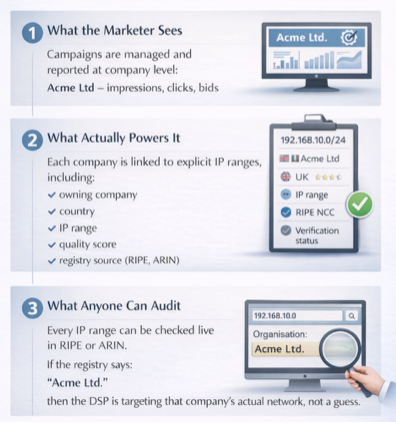
AccountInsight enforces a three-layer control chain.
1. What the Marketer Sees
Campaigns are managed and reported at company level:
Acme Ltd.– impressions, clicks, bids
2. What Actually Powers B2B Advertising
Each company is linked to explicit IP ranges, including:
- owning company
- country
- IP range
- quality score
- registry source (RIPE, ARIN)
- verification status
3. What Anyone Can Audit
Every IP range can be checked live in RIPE or ARIN.
If the registry says:
“Acme Ltd”
then the DSP is targeting that company’s actual network, not a guess.
This makes AccountInsight transparent by design, not by trust.
How Hybrid Work Is Handled
Companies do not disappear when people leave the office. AccountInsight manages hybrid work in two ways.
Enterprise VPNs
Employees in regulated roles (finance, engineering, HR, healthcare, IT) connect through corporate VPNs, which place them back inside the company network and make them fully addressable by IP .
Campaign-level cookie retargeting
With consent, AccountInsight drops a campaign cookie after the first corporate-IP impression. If the same user later appears on a different network, they can still be reached, typically extending reach by 5–10% of the account .
IP defines the account. Cookies extend continuity.
Why Purpose-Built B2B DSPs Outperform B2C Platforms
Consumer DSPs were never designed for corporate buying. They cannot:
- cap frequency by company
- manage IP truncation by SSPs
- prevent a few accounts from consuming all impressions
Around 50% of SSP traffic truncates the last IP octet, which can cause impressions to be misattributed unless explicitly managed — something generic DSPs cannot do .
AccountInsight was built to solve these problems at the bidstream layer, not after the fact.
The Bottom Line
B2B advertising only works when company identity is real. AccountInsight anchors account-based marketing in the only layer that is:
- legally defined
- technically targetable
- independently auditable
- compliant with privacy-first advertising
That is why its vision is simple:
Deliver your message to the right companies. Period.