Most B2B marketers assume that when someone from a company visits their website, that visit somehow belongs to the company’s digital footprint. In reality, this is only sometimes true. Whether that visit can be turned into a targetable account depends entirely on what kind of network carried the traffic.
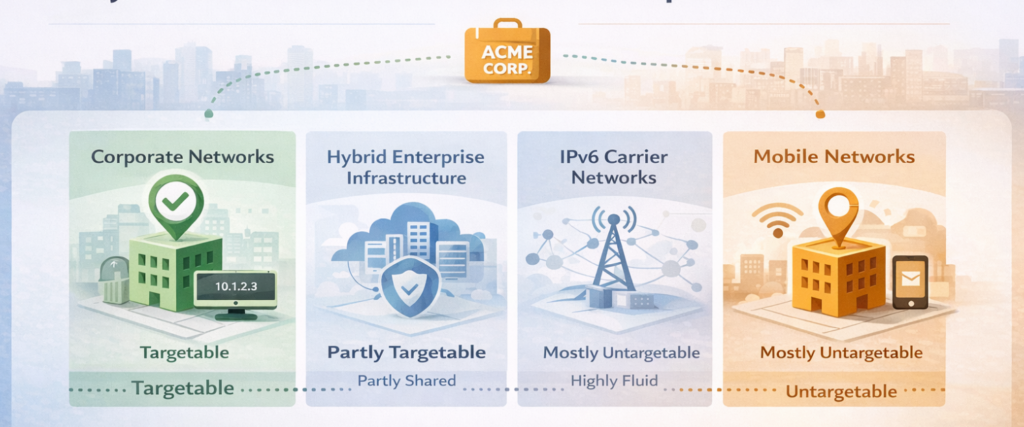
To understand why this matters, it helps to look at the four main types of networks that now carry B2B activity: corporate networks, hybrid enterprise infrastructure, IPv6 carrier networks and mobile carriers. These four environments behave very differently, and only some of them support true account-based advertising.
Corporate Networks: Why Large Enterprises Are Addressable
Large organisations are not just companies. They are network owners.
Banks, pharmaceutical groups, manufacturers, insurers, global logistics firms and technology multinationals all operate their own digital infrastructure. They run private WANs, data centres, secure cloud gateways, firewalls, VPNs and zero-trust access systems. For legal, security and compliance reasons, their internet traffic must exit through known, controlled IP ranges.
These IP ranges are:
- registered in RIPE, ARIN and other registries*
- associated with autonomous system numbers (ASNs)
- linked to legal corporate entities
This creates a stable, auditable network footprint. It is not optional. Financial systems, ERP platforms, regulated data, cybersecurity and compliance monitoring all depend on it.
This is why large enterprises are so easy to reach with IP-based B2B advertising. Their networks behave like fixed addresses on the internet. When a DSP targets their IP ranges, it is genuinely targeting the company.
This is the technical foundation of true account-based marketing.
*Note: Regional Internet Registries (such as RIPE NCC and ARIN) require that all IP address allocations and assignments are registered to specific organisations in their public databases, with contact and status information kept accurate over time. https://www.ripe.net/publications/docs/ripe-826/
Hybrid Networks: Where Corporate Identity Starts to Blur
Modern companies are no longer confined to their own data centres. They use cloud VPNs, outsourced IT platforms and shared enterprise infrastructure. In these environments, employees still work for the company, but the IP ranges may belong to cloud or connectivity providers rather than the organisation itself.
From an analytics perspective, this traffic still looks corporate. From a network perspective, however, it now runs through shared infrastructure.
Some of these environments remain mappable to a company or to a dedicated enterprise environment. Others do not. The result is a grey zone where company identity exists at a business level but becomes weaker at a network level.
This is where addressability starts to decline.
IPv6 and Carrier Networks: Where Identity Becomes Fluid
IPv6 now carries a growing share of European B2B traffic, especially for remote and mobile users. While IPv6 provides more addresses, most carriers implement it using shared, carrier-grade infrastructure. Thousands of users may pass through the same logical network, and addresses change constantly.
These networks are owned by ISPs and telcos, not by the companies whose employees are using them. Even if a person is logged into their corporate systems, their public internet presence belongs to a carrier.
This makes IPv6 traffic excellent for connectivity, but poor for company-level identification and targeting. The person is real. The company is real. The network is not theirs.
Mobile Carriers: The Most Extreme Form of Network Sharing
Mobile networks take this one step further. Mobile carriers route millions of users through shared gateways and NAT layers. From the outside, traffic from thousands of unrelated people appears to come from the same few carrier IPs.
A CFO, a sales rep and a student can all look identical at network level.
This is why mobile traffic is highly visible in cookie-based analytics but almost entirely unusable for IP-based company targeting.
How B2B DSPs Overcome the Limitations of IPv6 and Mobile Networks
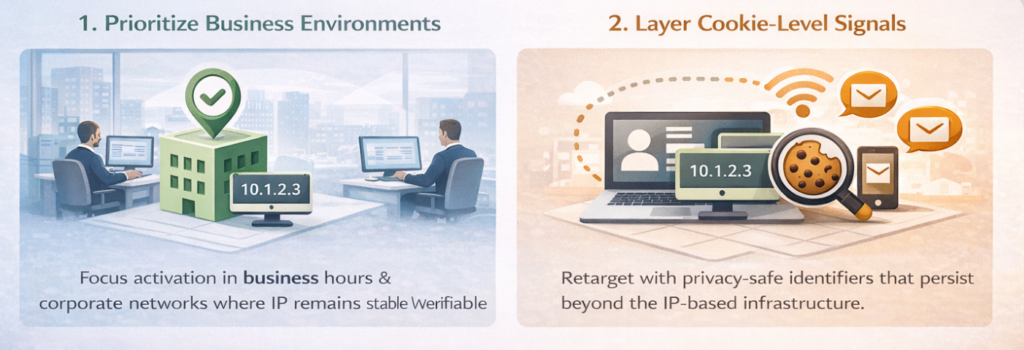
B2B DSPs such as AccountInsight address this in several complementary ways. First, enterprise-grade account-based campaigns are primarily activated in business environments, notably desktop and laptop traffic during working hours, where corporate networks and enterprise VPNs still dominate, and where IPv6 and mobile carrier traffic is far less prevalent. This preserves the integrity of IP-based company targeting for the majority of high-value impressions.
Second, campaign-level cookies and privacy-safe identifiers can be layered on top of IP targeting to support retargeting and sequential messaging even when a user later appears on a more fluid network. In this way, IP-based company identity provides the foundation for reaching the right organisations, while cookie-level signals allow continuity of engagement when individuals move between networks.
Together, this hybrid approach allows B2B DSPs to remain compliant, auditable and company-centric, while still operating effectively in an increasingly mobile and IPv6-driven internet.
Why Smaller Companies Are More Fluid and Less Addressable
This network reality explains one of the most important truths in B2B marketing:
The larger the organisation, the more addressable it is.
Large enterprises are forced by security, compliance and IT architecture to operate on stable, registered IP infrastructure. That is why they appear cleanly in IP-based systems and why ABM works so well for them.
Small and mid-sized businesses do not own networks. They use:
- business broadband
- home connections
- coworking spaces
- mobile hotspots
- consumer VPNs
- shared IPv6 infrastructure
Their internet footprint is fluid, shared and constantly changing. From a network perspective, the company barely exists.
This is why cookie-based systems “see” so many SMBs, while IP-based platforms cannot reliably target them. The identity lives with the person, not with the network.
What This Means for Account-Based Marketing
The strongest B2B strategies are built on a simple but often overlooked truth: not all companies are equally reachable on the internet.
IP-based networks determine which organisations can actually be addressed with advertising. Large enterprises operate on stable, registered network infrastructure because their business, security and regulatory obligations demand it. That makes them naturally well suited to account-based marketing. When a global manufacturer, bank or technology group is targeted via IP, the media genuinely reaches their digital perimeter in a controlled and repeatable way.
Smaller organisations operate very differently. Most SMBs do not own network infrastructure. Their traffic flows through consumer broadband, mobile carriers, coworking spaces, cloud VPNs and shared IPv6 environments. From a network point of view, these companies are fluid. They exist in CRM systems and cookies, but they do not exist as stable entities on the internet. That is why SMB-level ABM is inherently more probabilistic: the company is there, but the network may not.
Geography adds another critical layer. In regions such as continental Europe, where mobile usage and IPv6 adoption are high, a larger share of B2B traffic flows through carrier-grade networks. This increases the visibility of companies in analytics, but reduces their addressability in programmatic media. By contrast, in markets where corporate VPNs and fixed enterprise networks dominate, such as parts of Northern Europe, Germany or North America, IP-based company identity remains much stronger.AccountInsight is built for this reality. By anchoring ABM in clean, auditable, network-level company identity, it ensures that enterprise-grade campaigns are delivered where company presence is real and measurable.
Contact us today to see how we can help you identify and target your B2B traffic.