
In high-value B2B sales, traditional digital advertising often burns through marketing budgets with surprisingly little impact on pipeline. Many marketing teams still run B2B campaigns using consumer-style tactics: targeting broad demographics, buying generic interest categories, or measuring success based on website clicks.
In B2B environments – where purchasing decisions involve complex buying committees, long sales cycles, and five- to six-figure contracts – broad digital advertising fails because it targets individuals, not organisations.
This executive guide breaks down why legacy digital ads fall short and how an Account-Based Marketing (ABM) strategy aligns digital ad spend directly with revenue generation.
Key Takeaways for B2B Marketing Leaders
- The B2B Buying Reality: B2B purchasing decisions are made by multi-stakeholder buying committees (typically 5 to 12 people), not individual impulse buyers.
- Eliminating Wasted Spend: Traditional digital channels waste up to 80% of ad budgets on out-of-market individuals or non-decision-makers. ABM ensures 100% of impressions are delivered to verified target companies.
- The 95/5 Rule: At any given time, only 5% of your ideal accounts are actively in-market to buy. Sustainable growth requires continuous, account-level brand awareness across the other 95% before they enter an active buying cycle.
1. What is Account-Based Marketing (ABM)?
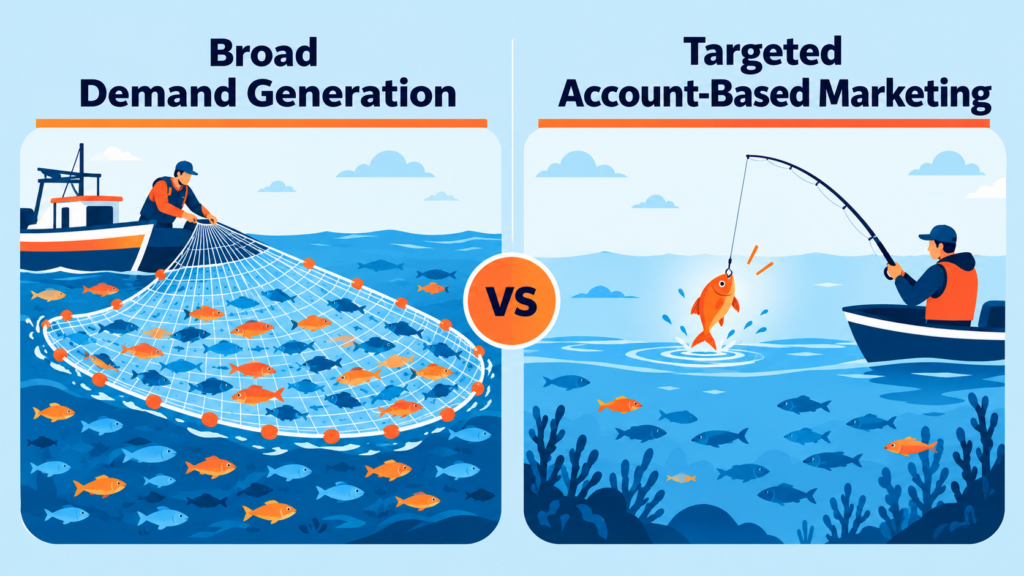
Account-Based Marketing (ABM) is a strategic B2B go-to-market framework that concentrates marketing and sales resources on a clearly defined set of high-value target accounts. Rather than casting a wide net to generate high volumes of unverified leads, ABM treats each target company as a distinct market of one, delivering personalized, account-level advertising and content directly to the key decision-makers within those organizations.
2. Why Traditional Digital Advertising Fails in B2B
Traditional digital advertising channels (such as generic display networks or consumer-focused ad exchanges) were architected for B2C e-commerce. Applying these tactics to B2B creates three fundamental structural failures:
Failure #1: Targeting Individual Profiles Instead of Buying Committees
In consumer marketing, a single individual sees an ad, clicks, and makes a purchase decision. In enterprise B2B, purchasing decisions are made by a buying committee consisting of finance, legal, technical, and executive stakeholders. Traditional B2C display targeting reaches a single user profile, leaving the rest of the committee entirely unaware of your solution.
Failure #2: Massive Ad Spend Waste
When running broad demographic or interest-based digital campaigns, up to 80% or more of your ad impressions are served to users who will never be qualified buyers – including job seekers, students, lower-level individual contributors, and non-target industries.
Failure #3: Misalignment Between Marketing and Sales
Legacy digital marketing measures success through vanity metrics like clicks, impressions, and form fills. However, sales teams do not need more random leads; they need access to specific companies on their target account list (TAL). When marketing pushes low-intent leads that do not fit the ICP, sales teams ignore them, creating friction between the two departments.
3. The 95/5 Rule: Capturing Out-of-Market Buyer Intent
A foundational concept in modern B2B growth is the 95/5 Rule (originated by the Ehrenberg-Bass Institute and the LinkedIn B2B Institute).
At any given time:
- 5% of your target accounts are actively in-market looking to purchase a solution.
- 95% of your target accounts are out-of-market, focusing on their daily operations.
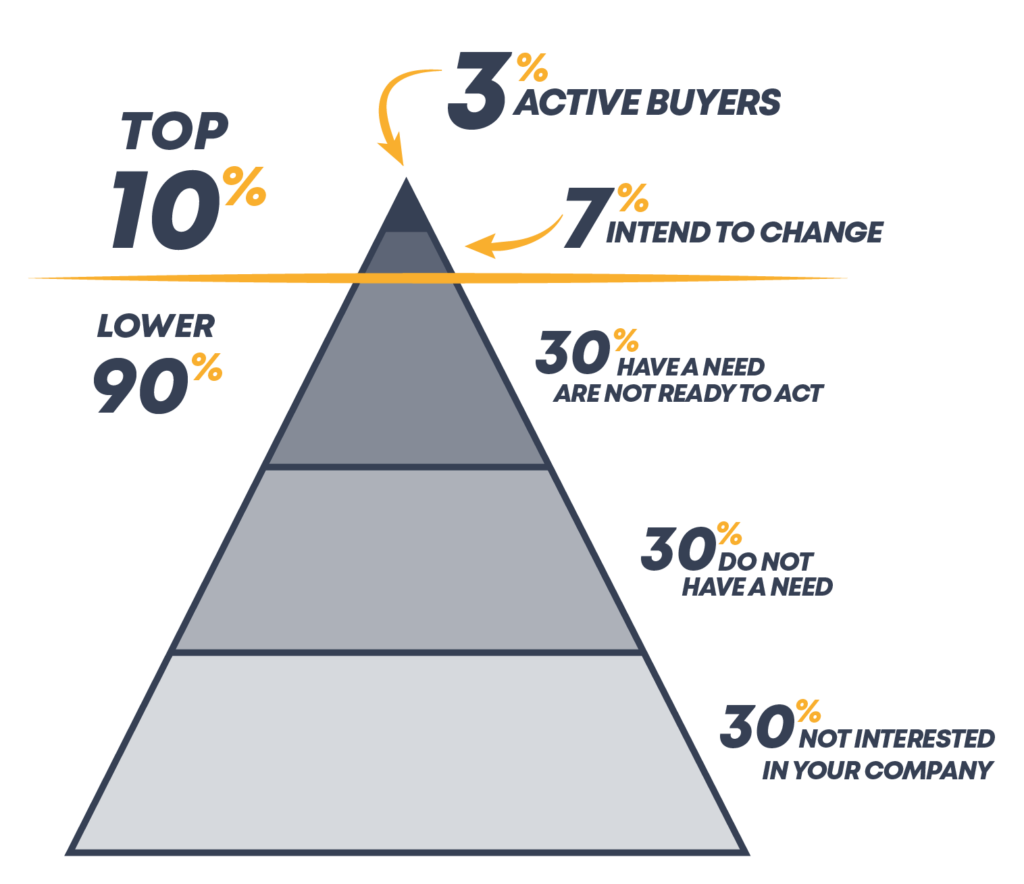
Traditional performance marketing heavily focuses on capturing the 5% through high-intent search ads or aggressive lead-gen tactics. However, because every competitor is bidding for that same 5%, Customer Acquisition Costs (CAC) skyrocket.
An account-based strategy builds sustained, multi-channel brand awareness across the 95% of accounts before they enter a buying cycle. When those accounts eventually enter the market, your brand is already trusted and top-of-mind, drastically shortening deal cycles and increasing win rates.
4. How ABM Programmatic DSPs Solve the Distribution Problem
To execute ABM efficiently at scale, B2B brands use dedicated B2B Demand-Side Platforms (DSPs) rather than generalist consumer ad platforms.
| Feature | Traditional Consumer DSP / Display | Dedicated B2B DSP (AccountInsight) |
| Primary Targeting Unit | Individual cookies / personal device IDs | Verified corporate IP networks & company graphs |
| Inventory Source | Open web consumer ad streams | Premium business & industry publisher inventory |
| Audience Precision | Broad demographic / interest categories | Specific Target Account Lists (TAL) |
| Primary Metric | Click-Through Rate (CTR) & Cost Per Click | Account Penetration %, Engagement & Pipeline Lift |
By leveraging cookieless firmographic targeting and direct corporate IP mapping, an ABM strategy ensures that every ad dollar spent delivers impression density directly to the organisations that drive your business growth.
Book a demo to see how this works in practice.