A B2B campaign can deliver thousands of impressions and clicks without reaching many of the companies a sales team actually wants to win. For businesses with complex buying processes and high-value contracts, the challenge is not simply reaching more people. It is reaching commercially relevant organisations, often months before they are ready to buy.
Account-Based Marketing (ABM) addresses this problem by coordinating marketing and sales around a defined list of target companies. Account-based advertising is one way to activate that strategy through paid media. It complements, rather than automatically replaces, search, LinkedIn and other channels.
Three principles make the difference.
1. Target the companies that matter – not just broadly relevant audiences
Interest, demographic and contextual targeting can identify people likely to care about a topic. Yet someone browsing enterprise security content may work for a university, a consultancy or an organisation outside the advertiser’s ideal customer profile (ICP). Relevance to the topic does not necessarily mean relevance to the sales pipeline.
ABM starts with a target account list (TAL): the specific organisations worth prioritising. Company-based advertising then focuses eligible media buying on opportunities associated with those organisations. The purpose is not to guarantee exposure to every decision-maker; it is to reduce reliance on audiences that may be interesting but commercially irrelevant.
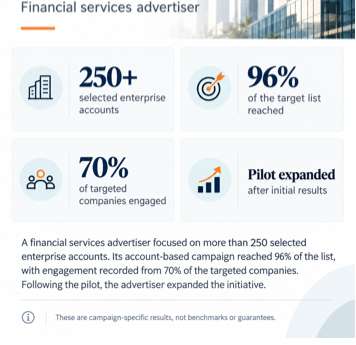
This changes the conversation from “How many clicks did we buy?” to “Which of our priority companies did we reach?” It also helps sales and marketing work from the same set of accounts.
2. Build familiarity before the buying cycle begins
Enterprise purchases rarely happen after a single advertisement. Buying committees, long evaluation periods and competing priorities mean that many potential customers are not actively considering a purchase today.
The widely discussed “95/5 rule”, associated with research by the Ehrenberg-Bass Institute and the LinkedIn B2B Institute, illustrates this reality: in many B2B categories only a small share of potential buyers is in-market at any one time. The 95/5 split is a useful mental model, not an exact ratio for every industry.
Search and intent-led activity can help capture demand that already exists. Consistent brand exposure among target accounts serves a different purpose: increasing the chance that a supplier will be recognised and considered when a relevant need eventually arises.
Evidence from an industrial campaign
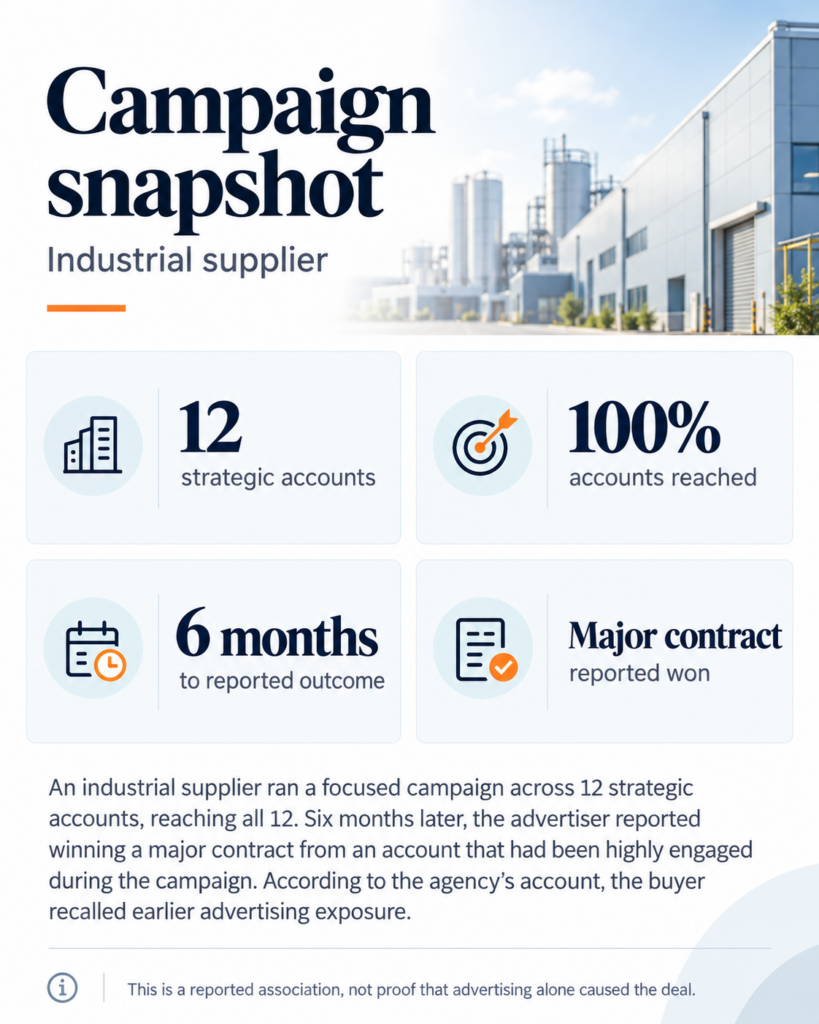
The lesson is to assess awareness activity over an appropriate buying horizon. A campaign with modest immediate conversions may still have helped establish familiarity within an account that becomes commercially relevant much later.
3. Measure account engagement alongside media performance
CTR, CPM, impressions and conversions remain useful. But campaign-level averages do not reveal whether the right organisations are receiving attention. ABM adds a company-level layer to reporting.
A simple measurement framework includes:
- Target-account reach: the share of companies on the target list receiving at least one impression.
- Impression distribution: how delivery is allocated across those companies, without assuming it represents unique employees.
- Account engagement: identifiable clicks or eligible company-level website activity, without treating activity as confirmed purchase intent.
- Pipeline progression: subsequent sales opportunities or closed deals, assessed alongside CRM data without assuming advertising caused them.
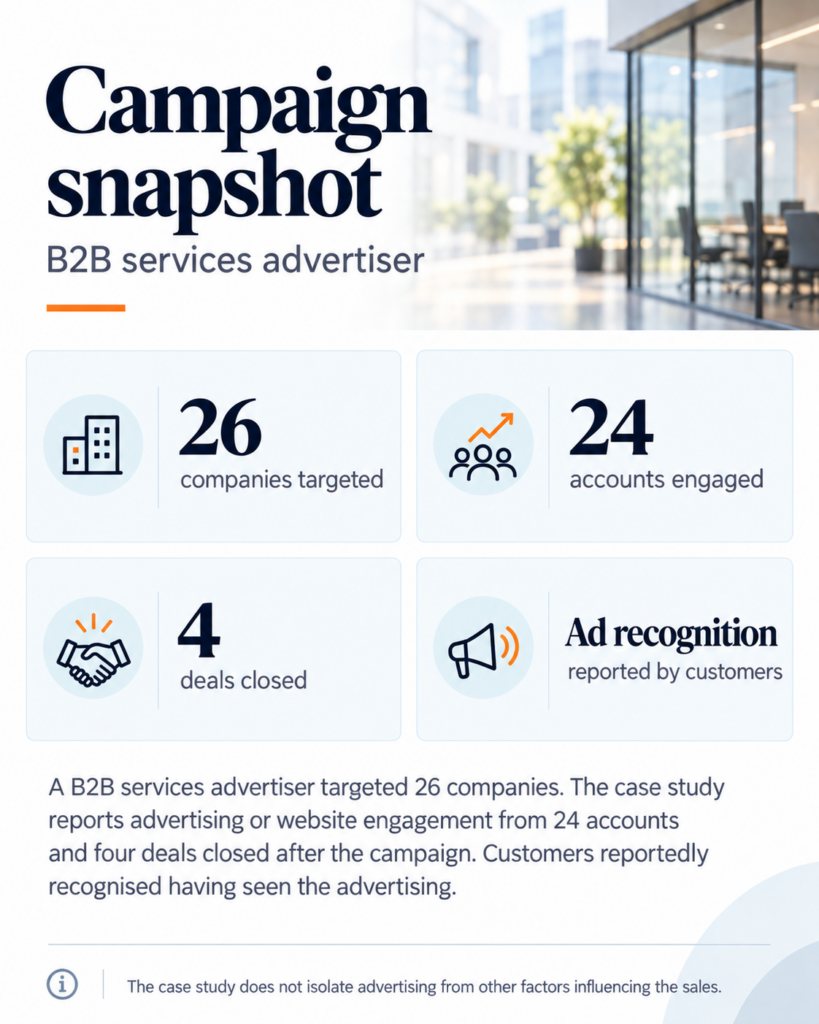
This illustrates why account-level reporting is useful: it connects a defined target list with observable activity and, where available, subsequent commercial outcomes. It does not turn clicks into individually identified decision-makers or establish causality.
How does AccountInsight support this approach?
AccountInsight is a specialist B2B demand-side platform (DSP) that activates named target-company lists through programmatic advertising. Its core company-IP targeting uses business-network intelligence to identify eligible ad opportunities associated with selected organisations. Advertisers can then assess delivery and engagement at account level, including eligible company-level website activity when tracking is implemented.
This is an organisational targeting method, not person-level identity verification. Corporate-network coverage, VPN usage, remote work, geography and available advertising inventory affect which accounts can be reached. Core IP-based targeting does not require third-party cookies, but applicable privacy and advertising requirements still apply.
The practical role of AccountInsight is to bring company selection, programmatic delivery and account-level reporting closer together. LinkedIn may remain useful for professional-profile targeting; search advertising remains useful for active demand. Account-based programmatic advertising adds another channel for reaching priority organisations across eligible open-web inventory.
Frequently asked questions
What is the difference between ABM and traditional demand generation?
ABM prioritises named companies and coordinates sales and marketing activity around them. Broader demand generation can reach a larger market and capture interest from companies not yet on a target list. The two approaches can work together.
Can company-IP advertising reach an entire buying committee?
Not reliably or by guarantee. It identifies eligible advertising opportunities associated with corporate networks, not the identities or job titles of individual viewers.
What is the best KPI for an account-based advertising campaign?
It depends on the objective. Start with target-account reach for awareness, add company-level engagement for consideration, and compare results with pipeline progression when reliable sales data is available.
The takeaway
B2B advertising does not fail simply because it uses traditional digital channels. It underperforms when targeting and reporting do not reflect which organisations the business needs to influence. A practical ABM approach puts three priorities first: select the right companies, stay visible before they are ready to buy, and measure engagement at account level.
Book a demo to discover how AccountInsight helps advertisers activate target-company lists and measure account-level campaign results.