
Most discussions around selecting a Demand-Side Platform (DSP) gravitate toward features. Procurement teams and marketers evaluate user interfaces, reporting dashboards, optimization tools, and native integrations. While these elements are undoubtedly useful for daily operations, they are rarely the primary driver of campaign success.
When you examine how DSPs consistently win business and deliver sustained return on ad spend (ROAS) over time, a simpler pattern emerges: they possess a foundational capability that competitors struggle to replicate.
In the open programmatic ecosystem, that advantage generally comes down to two variables:
- Unique media inventory
- Differentiated data
Because premium ad inventory is rarely exclusive anymore, most DSPs access the same major exchanges, data has become one of the most important competitive levers influencing campaign performance.
Why Data Is the Real Differentiator in DSPs
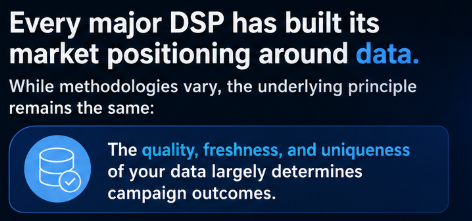
Every major DSP has built its market positioning around data. While methodologies vary, the underlying principle remains the same: the quality, freshness, and uniqueness of your data largely determines campaign outcomes.
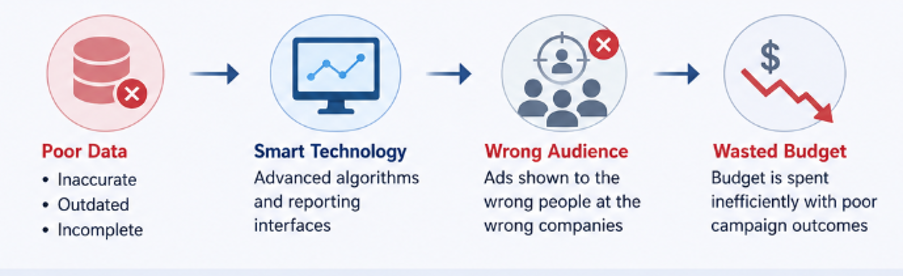
If your data is inaccurate, outdated, or incomplete, even the most sophisticated bidding algorithms and reporting interfaces cannot prevent budget from being spent on the wrong audience.
This reality becomes even more important in B2B advertising, where marketers are not simply trying to influence individual consumers but entire buying committees inside specific companies.
B2B Programmatic Advertising Has a Completely Different Problem to Solve
In Business-to-Consumer (B2C) advertising, targeting individual users is often sufficient. If a platform can identify someone who has demonstrated interest in running shoes, travel, or home insurance, it can serve an ad and potentially generate a conversion.
B2B programmatic advertising is fundamentally different.
Rather than reaching anonymous consumers, B2B marketers often need to reach:
- Specific companies
- Named target accounts
- Buying committees
- Decision-makers and influencers within enterprise organisations
This is the foundation of Account-Based Marketing (ABM) and Account-Based Advertising (ABA).
Yet despite these differences, many mainstream DSPs still rely heavily on consumer-oriented targeting methodologies to execute B2B campaigns, including:
- Modelled Audiences: Lookalike groups designed to resemble B2B buyers.
- Behavioural Proxies: Assumptions about professional roles based on browsing behaviour.
- Inferred Intent: Predictions about business needs based on fragmented behavioural signals.
These approaches can generate significant scale, but they become substantially less effective when advertisers need guaranteed delivery to specific target accounts.
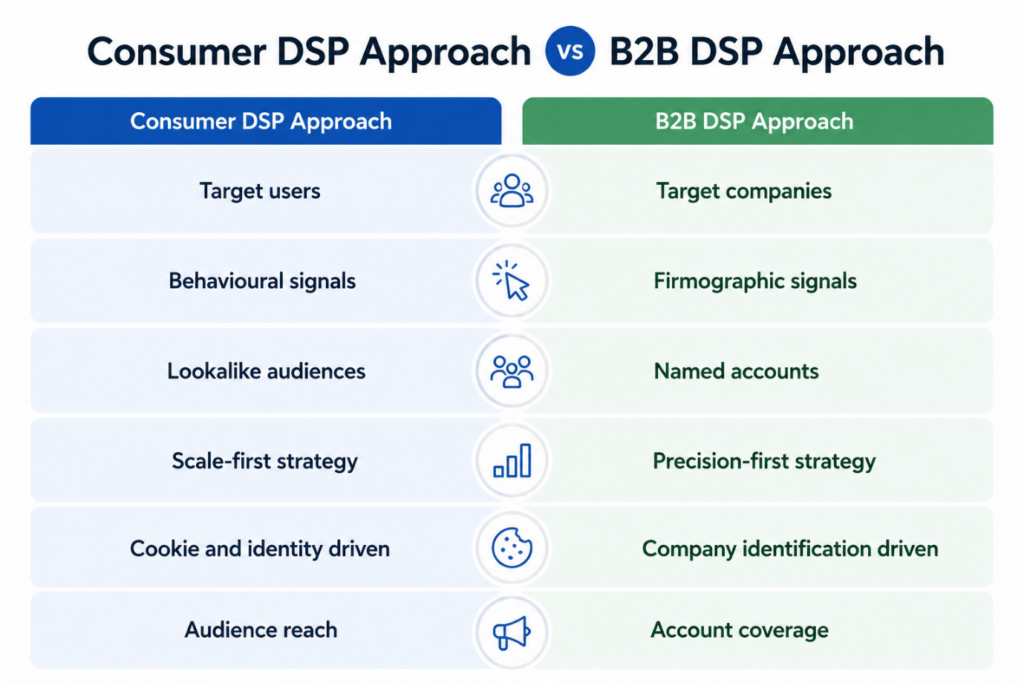
The Difference Between Consumer DSPs and B2B DSPs
The distinction between consumer and B2B programmatic advertising becomes clearer when comparing their underlying targeting approaches.
For consumer campaigns, reaching large audiences is often the goal.
For B2B programmatic ad campaigns, success is frequently measured by the ability to reach specific companies that are capable of becoming customers.
Why Precision Matters in B2B Buying Cycles
Research from Gartner indicates that B2B purchasing decisions often involve multiple stakeholders across different departments.
In enterprise environments, purchasing decisions can involve six to ten or more participants, including: Business decision-makers, technical evaluators, procurement teams, executive sponsors and end users
As a result, reaching a single individual rarely provides sufficient coverage of a target account.
Modern Account-Based Marketing strategies increasingly focus on account penetration and buying committee coverage rather than individual-level conversions. This shift places greater importance on company identification and account-level targeting accuracy.
The Limitation of Traditional DSP Targeting in B2B
When B2B marketers rely on probabilistic targeting, they are often operating within a framework of approximation.
The platform attempts to determine:
- Who might work at a target company
- Who might influence a purchase decision
- Who might currently be in-market
The challenge is that these assumptions cannot always be validated at scale.
As a result, advertisers may end up serving ads to individuals who resemble their target audience rather than employees of the actual companies they are trying to reach.
For enterprise campaigns built around target account lists, this can create significant inefficiencies.
If you cannot reliably reach the accounts that drive your sales pipeline, campaign performance becomes difficult to predict and optimise.
AccountInsight: A DSP Built for B2B Precision
AccountInsight takes a different approach to B2B programmatic advertising.
Rather than adapting consumer-focused methodologies, the platform was designed specifically to address the company identification challenge that sits at the heart of account-based advertising.
AccountInsight enables deterministic company-level targeting through verified corporate network infrastructure and firmographic data.
Instead of relying primarily on cookies, lookalike audiences, or inferred identity signals, advertisers can align campaign delivery directly with their target account lists.
This allows marketing and sales teams to operate from the same account universe, creating stronger alignment between campaign execution and revenue objectives.
How Deterministic Data Improves B2B Campaign Performance
When advertisers shift from probabilistic targeting to deterministic company-level targeting, several advantages emerge.
1. Measurable Account Coverage
Because targeting is aligned with verified company identifiers, marketers can better understand which target accounts have been exposed to campaign messaging.
This provides a more meaningful view of account engagement than traditional audience metrics alone.
2. Reduced Media Waste
Every impression delivered outside the target account universe represents budget that could potentially have been allocated more effectively.
More accurate company identification helps concentrate spend on organisations that fit the ideal customer profile.
3. More Relevant Messaging
When advertisers know which company is receiving an impression, creative strategies can be aligned with:
- Industry vertical
- Account tier
- Geographic market
- Sales stage
- ABM segment
This enables a higher degree of relevance throughout the enterprise buying journey.
4. Stronger Marketing and Sales Alignment
Because campaign delivery is tied directly to target account lists, marketing teams and sales teams can operate using the same strategic framework.
This alignment is one of the core principles behind successful Account-Based Marketing programmes.
Why Data Matters More Than Features
Features matter.
Reporting matters.
Integrations matter.
User experience matters.
However, these capabilities cannot compensate for poor targeting data.
A beautifully designed platform that delivers ads to the wrong audience will almost always underperform a platform with stronger company identification and targeting accuracy.
In B2B programmatic advertising, the quality of your data often determines:
- Who sees your ads
- Which accounts are reached
- How efficiently budget is spent
- How effectively campaigns support pipeline generation
For this reason, data remains one of the most important factors when evaluating a B2B DSP.
Conclusion
In B2B programmatic advertising, campaign performance depends on more than user interfaces, dashboards, optimisation features, or pricing structures.
Success ultimately depends on the ability to identify, map, and reach the right companies.
As Account-Based Marketing continues to gain adoption, advertisers are increasingly shifting their focus from audience targeting toward account targeting, from probabilistic assumptions toward deterministic accuracy, and from scale-first strategies toward precision-first execution.
The future of B2B programmatic advertising will not be determined solely by who has the most features.
It will be shaped by who has the most accurate data.
If your goal is to reach named accounts, buying committees, and high-value enterprise prospects, company-level targeting accuracy becomes the foundation upon which everything else is built.
Read our blog on how AccountInsight is the B2B DSP alternative to see how you can stop overpaying for LinkedIn advertising.
Or book a demo to talk to one of our specialists about how our B2B DSP can improve your B2B programmatic advertising.
Frequently Asked Questions
What is deterministic B2B targeting?
Deterministic B2B targeting identifies and reaches specific companies using verified business identifiers and corporate network data rather than inferred audience models.
What is the difference between account targeting and audience targeting?
Audience targeting focuses on individuals who match behavioural characteristics. Account targeting focuses on specific companies that have been selected as target accounts by the advertiser.
Why is data important in a B2B DSP?
Data determines whether advertising spend reaches the intended companies. Better company identification generally leads to higher account coverage, less media waste, and more relevant engagement.
What is B2B IP targeting?
B2B IP targeting is a method of delivering advertising to business networks associated with identifiable companies, helping advertisers align campaigns with target account lists and Account-Based Marketing programmes.
Why do many consumer DSP approaches struggle in B2B advertising?
Consumer DSPs are primarily designed to reach individuals based on behavioural and identity signals. B2B campaigns often require accurate company identification and account-level precision, which presents a different targeting challenge.