What Is a B2B DSP Alternative — and Why Should You Care?
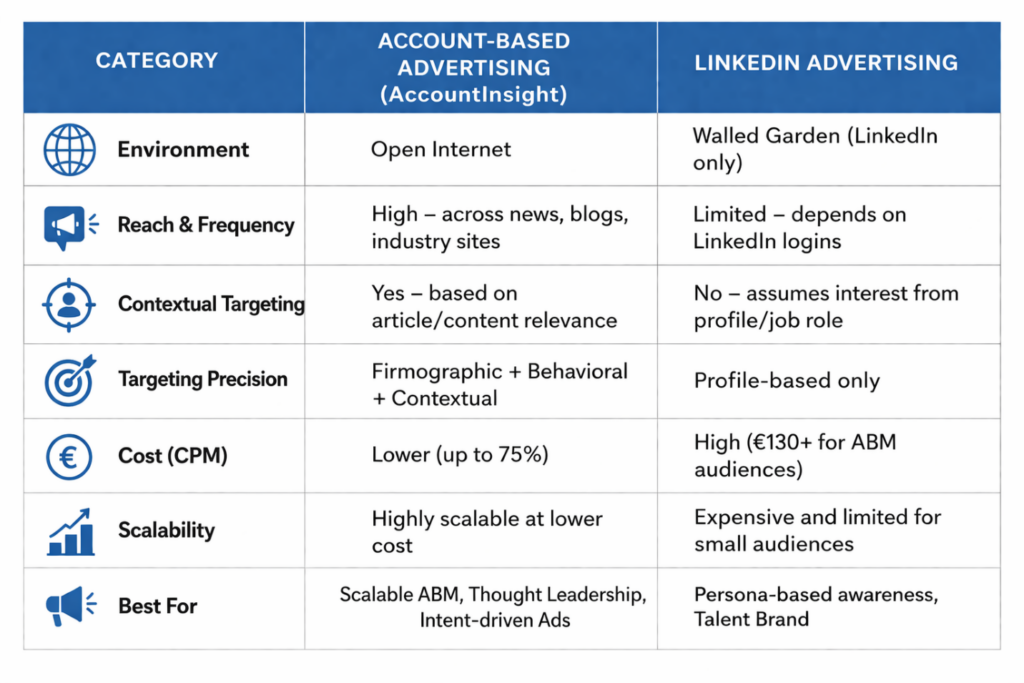
If you run B2B advertising campaigns, chances are LinkedIn takes a massive share of your budget. And for good reason, it’s where professionals go. But here’s the uncomfortable truth: LinkedIn’s walled-garden model means you’re paying premium CPMs (often €130 or more for ABM audiences) while being limited to a single platform, a single inventory source, and profile-based targeting that only scratches the surface of buyer intent.
A B2B DSP alternative flips that equation. Instead of confining your ads to one social network, a B2B-specialised demand-side platform like AccountInsight lets you reach the same decision-makers across the open internet, on the news sites, industry publications, and blogs they actually read during their workday, at a fraction of the cost.
The Core Problem with LinkedIn-Only B2B Advertising
LinkedIn advertising works well for persona-based awareness and employer branding. But when the goal is pipeline generation, deal acceleration, or scalable account-based marketing, its limitations become expensive:
Limited reach and frequency. Your ads only appear when targets log into LinkedIn. That’s a narrow window compared to the hours professionals spend reading industry content elsewhere on the web.
No contextual targeting. LinkedIn infers interest from job titles and profile data. It doesn’t know whether someone is currently reading an article about cloud migration or supply-chain software, context that signals real-time relevance and intent.
High and rising CPMs. With every B2B advertiser competing for the same LinkedIn inventory, costs keep climbing. For account-based audiences, CPMs of €130+ are common, making it difficult to sustain the impression frequency needed to influence a buying committee.
Profile-based targeting only. Job title and company size are useful filters, but they miss behavioural and contextual signals that reveal where an account sits in the buying journey.
How a B2B DSP Alternative Solves These Problems
A purpose-built B2B DSP like AccountInsight was designed from the ground up for business-to-business advertising. Here’s what changes when you move beyond LinkedIn’s walled garden.
1. Open Internet, Wider Reach
Instead of a single platform, your ads run across thousands of premium publisher sites: industry news, trade publications, technology blogs, and business media. This means more touchpoints with your target accounts throughout their working day, not just during their LinkedIn scroll.
2. Firmographic + Behavioural + Contextual Targeting
This is where a B2B DSP alternative truly outperforms LinkedIn. AccountInsight combines three targeting layers:
- Firmographic targeting: company size, industry, revenue, headquarters location
- Behavioural signals: which accounts are actively researching topics related to your solution
- Contextual relevance: serving ads alongside content that matches your value proposition
LinkedIn only offers the first layer (and a simplified version of it). A B2B DSP gives you all three, working together.
3. Dramatically Lower CPMs
Open-internet inventory is fundamentally more cost-efficient. Where LinkedIn charges €130+ CPM for ABM segments, a B2B DSP typically delivers comparable audiences at roughly 4 to 6 times more impressions for the same budget; or the same impressions at 75% less spend.
4. Scalable Account-Based Marketing
Running ABM on LinkedIn means high cost and small reach. A B2B DSP alternative makes ABM scalable: you can target hundreds or thousands of accounts with sufficient frequency to actually influence buying committees, without burning through your entire quarterly budget in weeks.
5. Intent-Driven Advertising
Rather than guessing interest from static profile data, a B2B DSP detects active buying signals. When a target account starts researching topics relevant to your product, your ads follow, appearing in the right context, at the right moment in the buyer journey.
Account-Based Advertising vs. LinkedIn: A Side-by-Side Comparison
When Should You Still Use LinkedIn?
This isn’t an either/or decision. LinkedIn remains effective for talent branding, recruiter marketing, and top-of-funnel persona awareness where job-title targeting alone is sufficient. The smart play is to use LinkedIn for what it does best and shift your performance-focused B2B spend to a DSP that delivers more reach, better targeting precision, and lower costs.
What Is a B2B DSP?
A B2B demand-side platform (DSP) is an advertising technology platform purpose-built for business-to-business marketers. Unlike general-purpose DSPs designed for consumer advertising, a B2B DSP integrates company-level data, firmographics, IP intelligence, intent signals, directly into the ad-buying process. This means every impression is evaluated against business criteria, not just demographic or cookie-based segments.
AccountInsight is a B2B DSP that connects programmatic buying with precise account-level targeting, intent data, and contextual intelligence, enabling marketers to reach the right companies, on the right content, at the right stage of the buying journey.
Getting Started with a B2B DSP Alternative
Shifting budget from LinkedIn to a B2B DSP doesn’t require a complete overhaul. Most teams start by reallocating 20–30% of their LinkedIn spend to test account-based display campaigns on the open internet. Within a few weeks, the data typically speaks for itself: more impressions, broader reach across buying committees, and a measurably lower cost per engaged account.
Ready to see the difference? Book a demo to find out how much further your B2B advertising budget can go.