Every B2B Team Has a Dream List. Most Have No Way to Advertise to It.
Sales teams live by their target account lists. Whether you call it the “Dream 100,” a named-account strategy, or a Tier 1 ABM list, the idea is simple: there’s a finite set of companies that would transform your business if they became customers.
The problem? Most advertising channels weren’t built to reach a specific list of companies. Social platforms target job titles. Search targets keywords. Display networks target demographics. None of them let you say: “Show my ads only to people browsing from these 100 companies.”
IP ads do exactly that. By matching company IP ranges to your target account list, IP ads let you serve display advertising exclusively to the organisations you’ve chosen, across the open internet, on the sites their employees actually visit during the workday.
This post walks through how to build and run a Dream 100 campaign using IP ads, step by step.
What Are IP Ads?
IP ads are display advertisements delivered to users based on the IP address of the network they’re browsing from. In a B2B context, this means matching corporate IP ranges to specific companies, so your ads only appear to people browsing from a target organisation’s network.
Unlike cookie-based or profile-based targeting, IP targeting works at the company level. You’re not guessing that someone might work at Siemens because their LinkedIn profile says so, you’re reaching devices connected to Siemens’ corporate infrastructure.
This makes IP ads uniquely powerful for account-based marketing. You define the exact list of companies, and only those companies see your campaigns.
Why IP Ads Are the Best Channel for a Dream 100 Strategy
A Dream 100 strategy is inherently about precision and concentration, putting disproportionate effort into the accounts that matter most. IP ads align perfectly with that philosophy for several reasons.
Zero waste
Every impression goes to a company on your list. There’s no audience bleed, no “similar audiences,” no algorithmic guesswork expanding your targeting beyond what you specified. If a company isn’t on the list, they don’t see the ad.
Full buying-committee coverage
A single decision at an enterprise account typically involves six to ten people. IP ads reach everyone browsing from that company’s network, not just the one contact whose email you captured. The CFO reading the Financial Times, the IT lead scanning a tech blog, the procurement manager checking industry news, they all see your message.
Open-internet reach
IP ads run across thousands of premium publisher sites, not inside a single walled garden. Your Dream 100 accounts encounter your brand on the industry news they trust, the trade publications they read daily, and the business media they browse between meetings.
Sustained presence
Building familiarity with a Dream 100 account takes time. IP ads let you maintain consistent visibility at a cost that’s sustainable for months, not just a two-week burst. With CPMs far below LinkedIn or other walled-garden alternatives, you can afford the frequency it takes to move a buying committee from unaware to engaged.
Step-by-Step: Running a Dream 100 Campaign with IP Ads
Step 1: Build Your Dream 100 List
Start with the companies that would have the highest impact on your revenue. Most teams build this list from a mix of sources: CRM data (best-fit closed-won profiles), sales nominations, firmographic filters (industry, revenue, employee count, geography), and strategic priorities from leadership.
Keep the list tight. The power of a Dream 100 campaign comes from focus. If your list grows to 500 or 1,000 accounts, you’re running a broad ABM programme, not a Dream 100 strategy. That’s fine too, but the messaging and budget allocation should differ.
Step 2: Map Accounts to IP Ranges
This is where a B2B DSP like AccountInsight adds critical value. AccountInsight maintains an extensive, continuously updated database of company-to-IP mappings. You upload your target account list, and the platform resolves each company to its associated IP ranges, including subsidiaries, regional offices, and multiple network locations.
Doing this manually would be impractical and error-prone. The platform handles the matching, validation, and ongoing maintenance as companies’ network infrastructure evolves.
Step 3: Layer Intent Data on Top
A Dream 100 list tells you who to target. Intent data tells you when they’re ready to listen. AccountInsight’s intent signals detect which of your target accounts are actively researching topics related to your solution. This lets you prioritise budget toward the accounts showing buying signals right now, while maintaining lower-frequency awareness campaigns for the rest.
Think of it as two gears: always-on visibility for the full Dream 100, and accelerated spend for the accounts currently in-market.
Step 4: Create Contextual, Account-Relevant Creative
Generic brand ads waste the precision that IP ads give you. When you know exactly which companies will see your campaigns, your creative can speak directly to their world.
Consider tailoring messaging by industry vertical (“Built for enterprise manufacturing”), by pain point (if intent data reveals the research topics), or even by account tier.
Step 5: Launch, Measure, Optimise
Key metrics for a Dream 100 IP ads campaign differ from standard display benchmarks. Focus on account-level engagement (which target companies are clicking, which are visiting your site), pipeline influence (are targeted accounts progressing through sales stages faster?), and impression share (are you maintaining sufficient frequency across the buying committee?).
AccountInsight provides account-level reporting so you can see exactly which Dream 100 companies your campaigns are reaching and how they’re responding.
What About Remote and Hybrid Workers?
A fair question. Not every employee browses from a corporate office anymore. AccountInsight addresses this by combining IP targeting with additional identification methods to maintain coverage even as work patterns shift. The platform’s approach to B2B identification goes beyond static IP-to-company lookups, incorporating multiple data layers to keep targeting accurate in a hybrid world.
IP Ads vs. Other Dream 100 Tactics
Most teams pursuing a Dream 100 strategy combine multiple channels. Here’s where IP ads fit alongside the alternatives.
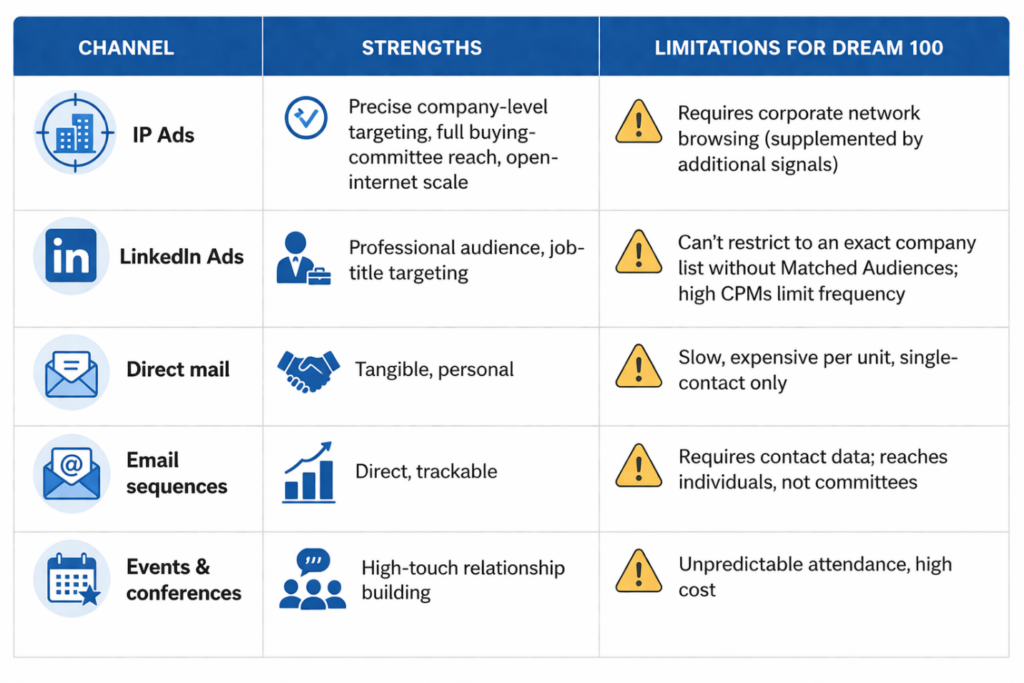
IP ads are rarely the only channel in a Dream 100 programme, but they’re often the most efficient way to create persistent, company-wide awareness that makes every other touchpoint, the sales email, the conference conversation, the LinkedIn message, land with more weight.
What Are IP Ads Best Suited For?
IP ads are most effective when your strategy depends on reaching specific, named companies rather than broad audience segments. Common use cases include: closing enterprise deals where multiple stakeholders need exposure to your brand, re-engaging stalled opportunities by staying visible to the full buying committee, supporting sales outreach so prospects recognise your brand before the first call, and defending existing accounts by maintaining presence during renewal or competitive threat periods.
Getting Started with IP Ads
If you already have a target account list or have identified your B2B traffic, you’re closer than you think. AccountInsight can map your Dream 100 to IP-targetable segments, layer on intent data to prioritise in-market accounts, and have campaigns live within days – not weeks.
Book a demo to see how IP ads can turn your Dream 100 list from a spreadsheet into a living, always-on advertising strategy.