In a world where AI assistants answer questions faster than Google can list them, how do B2B brands stay visible?
Traditional SEO isn’t dead but it’s no longer the only gateway to discovery. The rise of ChatGPT, Copilot, Perplexity … means decision-makers increasingly rely on AI-driven summaries and suggestions, not search results pages.
For B2B marketers, this shift reshapes how awareness is built and why display advertising is becoming the new visibility engine.
1. The Great Shift: From Search to Suggestion
For two decades, digital visibility revolved around one principle: be found in search results.
Now, the discovery path is changing. Executives researching a vendor or solution often start by asking AI tools, not typing keywords into Google.
Instead of sifting through dozens of blue links, we get instant answers, curated and contextualized content.
The challenge?
AI assistants tend to reference brands already known, linked, or frequently mentioned online. If your brand isn’t part of that ecosystem, you risk disappearing from the shortlist entirely.
2. The Trust Paradox
Ironically, while AI makes discovery more efficient, it also raises the bar for brand trust.
Users may trust an AI’s answer but only if they already recognize or recall the brands it suggests.
This creates a paradox:
“AI discovery works best for brands that were already visible before the question was asked.”
In other words, awareness becomes a prerequisite for even being considered.
That’s where B2B Display Advertising and Account-Based Marketing (ABM) re-enter the picture:
by keeping your brand name top of mind among decision-makers long before they type a query.
3. SEO Isn’t Dead, But It’s Different
Let’s be clear: SEO still matters. But its purpose is shifting from traffic driver to trust builder. Optimized content, structured data, and topic authority still feed both Google and AI crawlers.
However, the visibility layer, the moment when someone first sees or recalls your brand, now happens outside the search results.
That means your content strategy must evolve:
- Think “AI-readable,” not just keyword-rich – Use clear Q&A structures, schema markup, and natural language phrasing that AI systems can interpret easily.
- Focus on topics, not terms – AI models cluster information semantically. Covering themes comprehensively is more effective than chasing individual keywords.
- Refresh older pages – AI tools rely on recent data; outdated pages may simply be ignored.
4. Display Advertising as the New Discovery Layer
So, if SEO builds credibility, what drives awareness in this new landscape?
B2B Display Advertising plays a new and critical role.
Unlike search ads, which rely on someone asking, display can reach decision-makers proactively, in their professional context. It ensures that when an AI tool (or a human) later references potential vendors, your brand already exists in the mental shortlist.
Why this matters:
- Visibility precedes consideration. AI recommendations mirror what’s visible and trusted.
- Brand familiarity boosts engagement. Even when search clicks decline, recognized names get higher CTRs and longer time on site.
- Corporate targeting keeps it efficient. Platforms like AccountInsight reach verified business IPs, ensuring impressions come from real company audiences, not anonymous traffic.
Think of Display as teaching the algorithm who you are before anyone asks.
5. Rethinking the Marketing Funnel
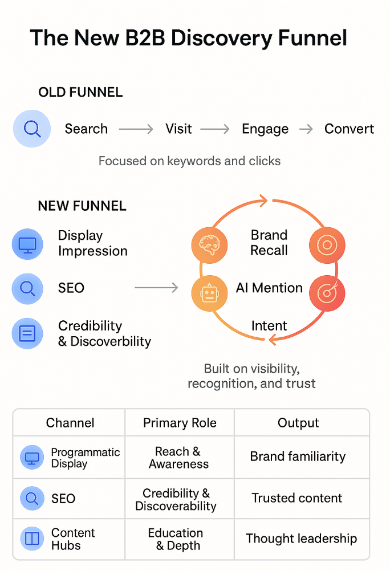
Traditional funnels assumed a linear journey: Search → Visit → Engage → Convert.
Now it looks more like: Display Impression → Brand Recall → AI Mention → Intent → Conversion.
The first step, being known, happens far earlier and through passive exposure.
That’s why smart B2B marketers are combining:
- Programmatic Display for reach and awareness.
- SEO for credibility and discoverability.
- Content hubs for education and long-tail authority.
Each channel reinforces the others in an ecosystem built around recognition, not just clicks.
6. Practical Steps to Future-Proof Visibility
If you’re optimizing for the post-SEO era, here’s where to start:
- Audit your content footprint – Are your articles structured clearly for both Google and AI parsing (e.g., headings, lists, schema)?
- Create thought-leadership pieces – Focus on insight-led, opinion-based content that earns citations; AI systems value frequently referenced voices.
- Expand brand reach through Display – Target the companies you want to influence, not just the keywords they might search for.
- Integrate data – Use analytics to connect Display exposure with organic visits. Even if search traffic declines, your brand recall metrics should rise.
- Measure what matters – Beyond clicks; track company engagement, repeat visits, and mentions in third-party content.
7. The New Marketing Reality
In an AI-driven discovery world, visibility precedes search. Buyers don’t need to look for you, they need to remember you.
That’s the true role of modern B2B Display Advertising: ensuring your brand remains discoverable, trusted, and recommended, whether the next buyer is using Google or ChatGPT.
Final thought
“The brands winning in the AI era won’t just rank, they’ll resonate.”
And that’s exactly where AccountInsight helps: by connecting B2B marketers with verified company audiences through high-precision Display and ABM activation; keeping brands visible in a world where discovery happens everywhere.